The internet met your digital self before you did.
This page can already place you near that pin, read your device, and pick you out of the crowd.
Every page you open is reading you like this — most never say so.

Chrome extension
See what every site takes — and what it's worth.
Pulse Observer names the trackers on the pages you visit and prices what they extract. Free on the Chrome Web Store, and nothing it observes leaves your browser.
The truth
You have a digital self. The internet met it before you did. Now you get to meet it — and take it back.
The instrument panel, in view
This is what a session already reveals.
Every fact below came from ordinary browsing — no typing, no clicks, no permission prompt. Most sites collect the same signals. Almost none show you this panel.
Last observed signal · passive arrival
Your GPU, by name
ANGLE (Google, Vulkan 1.3.0 (SwiftShader Device (Subzero) (0x0000C0DE)), SwiftShader driver)
Bot-detection and ad-fraud vendors use the exact GPU string to tell real hardware apart from emulators and click farms.
Canvas fingerprint
fp-707c41bf
The everyday retargeting ad — shoes on one site, shoe ads everywhere after — mostly runs on cookies. Canvas hashing is the fallback ad-tech uses to keep that link working once a cookie is blocked or cleared.
Tracking ID assigned to you
675afe4271b7bfa2ea797c5c58e2f896
The same fallback role, sold to data brokers and ad exchanges as a stable ID that outlives cookies.
Your timezone
UTC
Combined with IP-based geolocation to infer where you live and work, and when you travel.
Fingerprint from your speaker hardware
fp-5556c7b1
Another cookie-resistant ID — it survives private-browsing mode and cookie clearing, which is precisely why it gets used.
A second, independent ID that also picked you out
3072120303
A redundant ID on top of the others, kept so tracking survives even if one fingerprinting method gets blocked.
Your IP address
—
Every server you connect to logs this by default. Advertisers buy IP-linked household graphs that tie your phone, laptop, and TV together without a single cookie.
Roughly where you are right now
—
Paired with your device fingerprints above, this is enough to lock a 'household' of devices to one address — even across different browsers and private windows.
Your internet provider
—
The first thing most fraud- and bot-scoring systems check: residential, corporate, VPN, or data-center traffic, each priced and treated differently.
Browser, OS, and language
—
The baseline every other fingerprint gets checked against — a mismatch here is exactly what flags a spoofed or automated session.
The way out
What this site shows you is alarming. It should be.
You have been told there is nothing you can do about being monetized. You were told wrong.
We built this site and this extension to show you the way out. Not just blocking trackers. Opting out. Deleting what they already hold.
Not just reclaiming your privacy. Cutting you out of the supply chain that monetizes your daily life.
Privacy is a fundamental human right. We believe that. We live it. We built a way back to it.
It is explicitly recognized under international law — Article 12 of the Universal Declaration of Human Rights and Article 17 of the International Covenant on Civil and Political Rights.
And you can push further than protecting yourself — the Electronic Frontier Foundation, Privacy International, and noyb fight every day to turn that right into law and enforcement. Stand with them.
How far those facts actually go
Those facts already narrow you down to one person.
Each fact above adds a little more certainty. Combined, they don't just describe a device — they mathematically narrow a population of 330 million down toward exactly one candidate. The full report shows that math live, signal by signal, using this session's real values.
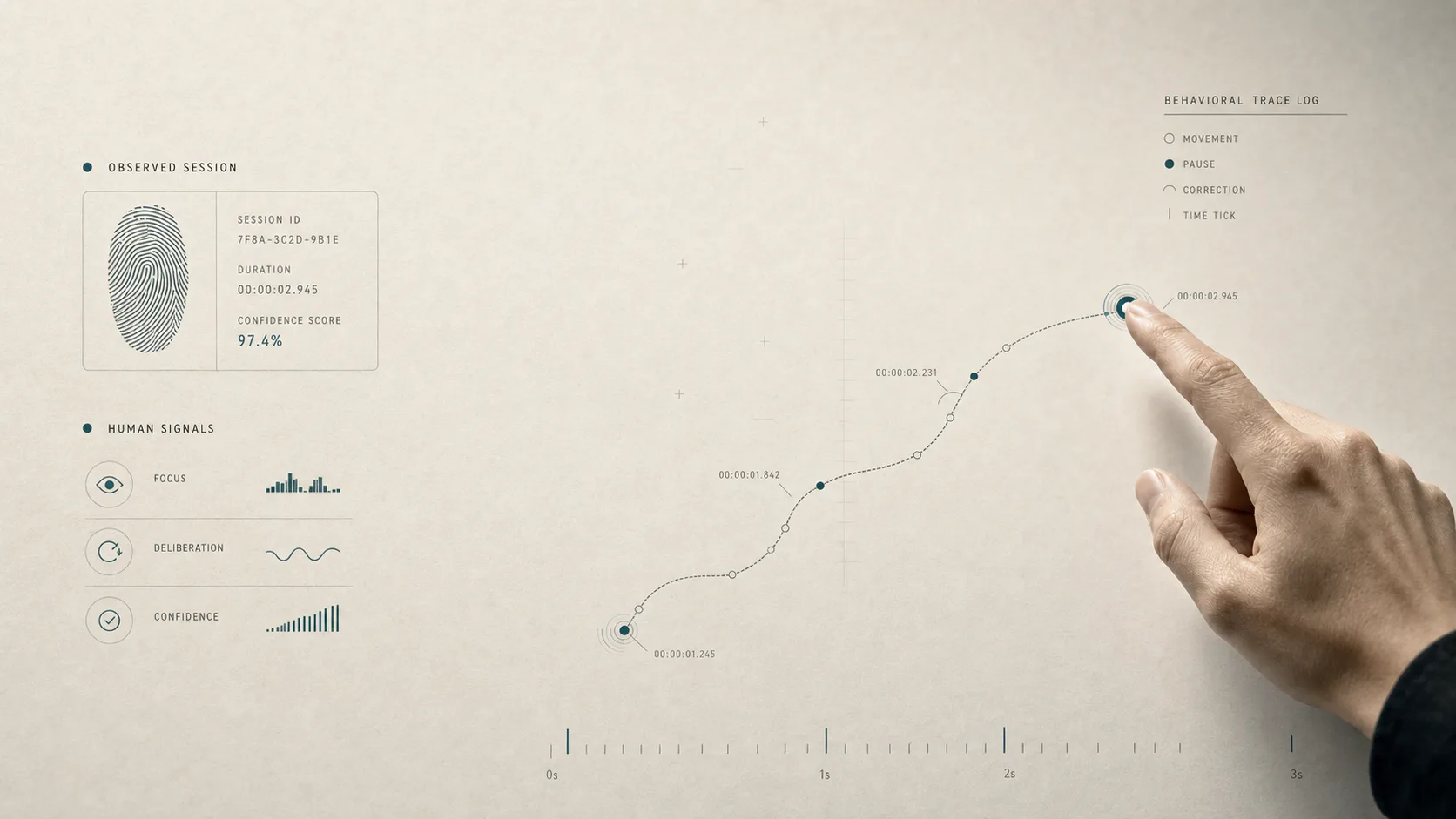
Or turn it on yourself: watch a session read itself back to you — where your pointer paused, where you corrected a keystroke, how long you took to decide. Same mechanism, live.